Mantanzas, Santería, and Headlines from the Island.
2 04 2008This past Saturday I spent my first night outside of Havana since I was in Toronto. That day and Sunday I was in Matanzas on a trip to learn all about Santería. We traveled aboard the guagua periodista which left us stranded last time I tried to take a trip on it. The bus showed up to the residence a few minutes early and left right on time—without any of us. An hour later, the driver told us he went to bread. Nevertheless, after about two bumpy hours on the highway, we arrived in Matanzas ready to begin our journey.
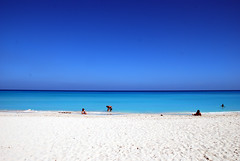
Some background: Matanzas is the province directly east of La Habana and its capital city is Matanzas. Within the province there are several spots of interest I hope to visit in the next month: Playa Girón (Bay of Pigs) and Veradero (allegedly home of the nicest beaches in Cuba). Santería is the hybrid religion that combines Catholicism with the traditional Yoruba religion of Nigeria. Barred from practicing their native religion and converted to Christianity, colonial slaves in Cuba kept their traditions alive by masking them with Catholic ones. The most obvious form of this practice is the connection between the orishas (spirits) and Saints. For example, Changó (the spirit of fire and war) is often connected with Santa Bárbara (that is not to say they are the same however).
With that covered, our first stop was the temple where we would also be staying on Saturday night. The Templo Otura Di was the first in Cuba (and second in the Americas) to ordain a female Babalawo (the spiritual leader of the temple roughly translating to “Father Who Knows the Secrets”). After learning about some of the customs and rituals of Santería, we traveled around the neighborhood to other templos to see the differences within the religion. Back at the Otura Di, we were part of a full ritual before spending some of the later hours exploring the city. Since we stayed in the houses of various santeros, there weren’t enough beds and I had the privilege of sleeping the back seat of a 1950s máquina.
Well rested, the next day we explored more of Matanzas before heading back to Havana on the bus. After my first night away from the capital, I was happy to be heading “home.” I’m also ready to get more aggressive about traveling around the island as much as I can. For the month of April I have a long list of places I’d like to visit including: Santiago de Cuba, Bayamo, Pico Turquino (the highest mountain in Cuba), Baracoa, Playa Girón, Isla de la Juventud, and the western most parts of Pinar del Río.
Aside from traveling, classes have been at a relaxed pace the past few weeks, but that just means we’ll be gearing up for another round of semanarios in the next few. If you’ve been reading the New York Times recently, you’ll notice that there are a lot of “major” changes happening here in Havana, all of them a loosening of restrictions that have been in place on Cubans for many years now. First was the legalization of the public sale of microwaves, DVD players, and eventually air conditioners, then garnering more headlines, the opening of the cell phone market to all Cubans. Just a few days ago, hotels were officially opened to all Cuban (who used to be prohibited from renting accommodations in tourist hotels even if they had the money to do so).
I’m not trying to take away from the significance of these changes, but would encourage people to think about them using a historical perspective. There’s a huge black market for items that the state doesn’t sell openly so any commodity that can be found on the island can be bought by a Cuban if they have the money to do so. The same goes for cell phones. The decision of the State to openly sell these items resulted from the need of Cuban’s to have access to these items as much as a necessity for the State which looses money when it doesn’t control the method of product distribution. The opening of hotels to Cubans is slightly more significant because that was something that could not be bought on the black market, although there were many ways for Cubans to gain official access to tourist hotels. We’ve now entered the “low” season as Europe warms up and tourism decreases and when you combine that with an overall decrease in tourism over the past few years, you’ll notice that this is a win/win for the state which gets to fill empty hotel rooms and make the (capitalist) world think that Cuba is changing.
What I find significant in these recent measures taken by Raúl Castro is that the government seems to be acknowledging that there are two classes of Cubans—those who have access to convertible pesos and those who don’t. There are two notable ways to gain access to convertible pesos: working in the tourist sector or for foreign businesses and having family residing abroad that sends remittances. From an economic standpoint, the growing availability of commodities available to Cubans with access to convertible pesos will serve as an additional incentive for Cubans to try and gain access to that type of currency. Given that the government can not increase salaries twenty-four fold, this means there is a greater incentive to work in the tourist sectors. Overall, I see the recent headlines as an acknowledgement of not only the existence of socioeconomic classes in Cuba, but more significantly, that the class of Cubans with convertible pesos is growing and gaining political power. Like everything, I’ll have to get in the cola to find out.